

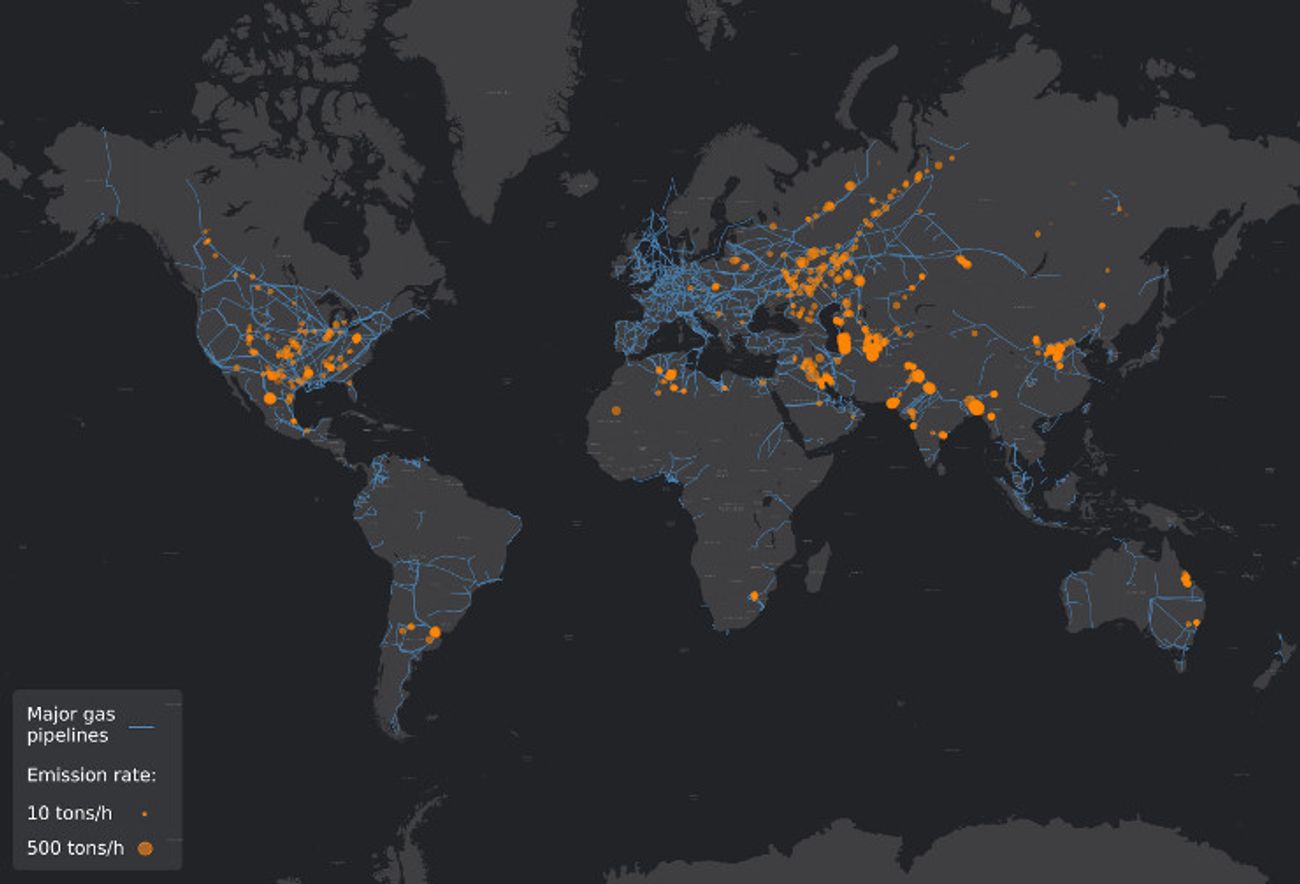
The IRA’s methane charges are on the horizon, but first we need to clean up the data.
Self-reported emission inventories by large oil and gas (O&G) operators in the United States are significantly underreported, inhibiting climate progress. Even when companies follow federal guidelines, emissions slip through the cracks because those guidelines follow simplistic assumptions of routine operations with minimal methane leakage. However, this reporting can miss “super-emitting” events, which are large enough to be seen by satellites and can contribute a substantial share of O&G emissions.
Empirical data can enhance emissions transparency, fill gaps in self-reported inventories, and guide O&G climate action. Without accurate accounting, policies like the new Waste Emissions Charge on O&G operators (under the US Inflation Reduction Act, IRA) will impose faulty fees. Validating self-reported emissions helps balance the climate books and close emissions inventory shortfalls. In turn, this informs more effective mitigation efforts and ensures fair implementation of the IRA’s new methane fee.
Today’s Simple Methane Estimates Encourage Under-Reporting
The US Environmental Protection Agency (EPA) oversees the Greenhouse Gas Reporting Program (GHGRP). Subpart W of this program requires O&G facilities — assets within a basin with the same owner or operator — emitting over 25,000 metric tons of carbon dioxide equivalent (CO2e) annually to self-report their greenhouse gas (GHG) emissions. Emissions estimations are mainly bottom-up, using generic emission factors and activity data, excluding considerations of site-specific equipment, malfunctions, and operations.
But O&G assets are not generic. They are operated differently with emissions varying markedly. This results in wide-ranging emissions between otherwise equivalent barrels of oil and gas. Analysis from open-source tools like the OCI+ suggests that 2021 GHGRP emissions underestimate America’s O&G sector emissions by over a factor of two.
Moreover, methane is primarily natural gas. This climate super pollutant has over 80 times the warming potential as carbon dioxide (CO2) over its decade-long lifetime. Since the EPA’s guidelines use global warming potentials of 100 years, methane’s short-term, high-impact warming is significantly downplayed. When methane’s 20-year global warming potential is considered, the GHGRP may undercount emissions by a factor of four.
Numerous empirical studies highlight Subpart W’s systematic underreporting of methane. A recent study of Permian Basin O&G operators estimated methane intensities (the ratio of methane emissions to natural gas or total energy produced) using remote sensing technology capable of detecting super-emitting events. Considering super-emitting events alone, measured methane intensities were, on average, over six times higher than reported in the GHGRP. Still, other studies find that O&G methane emissions in New Mexico are 6.5 times larger than the EPA estimates.
Exhibit 1 compares individual operators’ methane intensities (effective leakage rates) between self-reported emissions inventories (dark blue bar) and independently observed super-emitters (light blue bar). Gas sales (green diamonds) are plotted (right axis). From this small sample we find that high gas production does not infer high methane intensity, and that higher methane intensities can be prevalent at any level of production. Importantly, high methane intensities combined with high production volumes would contribute the greatest climate damage (e.g., Operator 9). Still, operators with high methane intensity with low gas sales (e.g., Operator 11) can also pose serious climate damage.
Exhibit 1: Super-emitter observations vs. reported emissions.

Using measured methane emissions matters fiscally and environmentally
Under the IRA’s Waste Emissions Charge, operators exceeding a 0.2% methane intensity of natural gas sold from the facility pay for excess methane emissions. But current GHGRP inventories fail to include many operators actually above this threshold. Aerial super-emitting methane intensities for these Permian Basin operators were on average over three times the 0.2% threshold. Some operators exceeded this threshold by almost nine times.
Applying the IRA Waste Emissions Charge’s proposed $900 per metric ton of methane to these GHGRP inventories would miss approximately $208 million in fees. Approximately $2 million in fees would be collected using current GHGRP inventories while using measured super-emitting data alone yields an estimated $210 million in fees, over 200 times higher. The Waste Emissions Charge is sensitive not only to methane intensity but also to gas volumes, so fees reflect and scale based on estimated climate damage. Without correction, this data gap will lead to even more lost revenue; the Waste Emissions Charge will charge $1,500 per metric ton of methane starting in 2026.
Exhibit 2: Differences in methane waste fees for a sampling of operators.

Hundreds of millions of dollars hang in the balance. Furthermore, this shortfall between self-reported GHGRP methane emissions and measured operational emissions creates perverse incentives and unfairly penalizes some operators while benefiting others.
Developing accurate O&G sector emissions inventories is doable. Some operators and numerous third parties have been measuring emissions data for years. Others use open-source, verifiable standards to certify their methane intensity. Measured methane data are increasingly integrating into bottom-up models like RMI’s OCI+ for forecasting global O&G emissions.
The US government recognizes the importance of emissions transparency for climate mitigation. IRA’s Methane Emissions Reduction Program includes financial and technical assistance for O&G emission reductions. This year, the EPA and the Pipeline and Hazardous Materials Safety Association (PHMSA) proposed a new “other large release events” reporting category to incorporate super-emitting events. The EPA’s other proposed revisions to Subpart W include expanded source coverage, updated emission factors, use of more empirical data, and increased public transparency. These changes — with several recommendations from RMI and Carbon Mapper — can vastly improve Subpart W emissions accounting.
Subpart W regulations will be effective in 2025, behind the Waste Emissions Charge, effective in 2024. Operators are in a critical window to improve their inventories, as 2025 inventories will reflect the combined effectiveness of these recent policies.
Accurate emissions inventories benefit all actors
A US carbon tax has long been discussed, but never adopted. IRA’s Waste Emissions Charge using accurate methane inventories can make history. Full accounting of methane emissions using empirical data can go a long way to incentivize climate action, highlight critical mitigation measures, and create public emissions transparency. These tools and incentives can catalyze owners and operators throughout the O&G supply chain, from producers to shippers and refiners.
Accurate reporting also informs O&G investors and buyers who aim to make better climate-aligned purchases. Providing regulatory agencies with sufficient data can also lead to more effective regulations targeting highlighted sources of methane emissions.
By putting a price on methane, emissions reduction can be factored into the industry’s economic decision-making. Given the highly competitive nature of the O&G industry, accurately pricing methane will make it matter in the marketplace. Increased monitoring and use of empirical data will guide operators to fix their largest emissions sources while rewarding operators with the lowest methane intensities. Given the large volume of gas flowing through today’s economy, the lower the methane intensity, the less climate-related damage imposed on the US and global population.
By Suzanne (Suzy) Schadel, Deborah Gordon, Frances Reuland, © 2023 Rocky Mountain Institute. Published with permission. Originally posted on RMI.
Have a tip for CleanTechnica? Want to advertise? Want to suggest a guest for our CleanTech Talk podcast? Contact us here.
EV Obsession Daily!
https://www.youtube.com/watch?v=videoseries
I don’t like paywalls. You don’t like paywalls. Who likes paywalls? Here at CleanTechnica, we implemented a limited paywall for a while, but it always felt wrong — and it was always tough to decide what we should put behind there. In theory, your most exclusive and best content goes behind a paywall. But then fewer people read it!! So, we’ve decided to completely nix paywalls here at CleanTechnica. But…
Thank you!
Tesla Sales in 2023, 2024, and 2030
CleanTechnica uses affiliate links. See our policy here.
